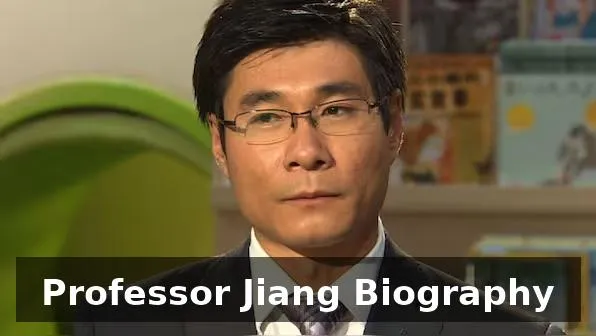
Professor Jiang Biography?
Jiang Xueqin, often referred to online as Professor Jiang, is a Chinese-Canadian historian, educator, and geopolitical commentator known for analyzing global politics through historical patterns. In recent years, he gained international attention after a lecture predicting major geopolitical events, including the political return of Donald Trump and the possibility of a future conflict involving the United States and Iran.
Professor Jiang has built a reputation for combining history, strategy, and political analysis to forecast future global developments. His work focuses on what he calls “predictive history,” a method that studies patterns from past civilizations and geopolitical conflicts to understand possible future outcomes.
Although he is primarily known as an educator and writer, Jiang’s lectures and online commentary have attracted large audiences on social media and video platforms. His predictions began trending online after viewers noticed that some of his earlier geopolitical analyses appeared to align with real-world political developments.
Because of these viral predictions and his analytical approach to global politics, some online commentators have even described Professor Jiang as “China’s Nostradamus.” While Jiang himself rejects the idea of prophecy, he emphasizes that his predictions are based on historical patterns, strategic thinking, and long-term geopolitical trends rather than supernatural insight.
His growing online following reflects increasing global interest in experts who attempt to interpret world events through historical analysis and geopolitical forecasting.
Early Life and Education of Professor Jiang
Jiang Xueqin was born in China and later moved to Toronto, Canada, where he spent much of his childhood and teenage years. Growing up in Canada gave him exposure to both Eastern and Western cultures, which later influenced his approach to studying history and global politics.
During his early years, Jiang developed a strong interest in literature, history, and international affairs. These interests shaped his academic path and encouraged him to pursue higher education in the humanities.
He later attended Yale University, one of the most prestigious universities in the world. At Yale, Jiang studied English literature and graduated in 1999. His studies helped him develop strong analytical and writing skills that would later become important in his career as a writer, educator, and geopolitical commentator.
After completing his university education, Jiang began exploring careers that combined journalism, education, and international affairs. His academic background and interest in global history eventually led him to focus on analyzing political events through historical patterns and strategic thinking.
This combination of cultural experience, education, and intellectual curiosity helped shape the perspective that would later define his work as a historian and geopolitical analyst.
Professor Jiang’s Prediction About Donald Trump in 2024
In May 2024, Jiang Xueqin—often called Professor Jiang—delivered a lecture that later went viral online. In the lecture, he presented a series of geopolitical predictions about the future of global politics, including the possible return of Donald Trump to power and the risk of a major conflict between the United States and Iran.
Jiang’s analysis was part of his “Predictive History” method, which attempts to forecast future events by studying historical patterns, political incentives, and geopolitical strategy. According to Jiang, similar patterns of conflict and leadership decisions appear repeatedly throughout history, making it possible to anticipate certain developments in world politics.
Below are the key elements of Professor Jiang’s prediction.
Professor Jiang Prediction Trump’s Return to Power
One of the most widely discussed parts of Jiang’s lecture was his prediction that Donald Trump could return to power in the United States. At the time of the lecture in 2024, the U.S. political environment was already highly polarized, and Trump remained a dominant figure in American politics.
Jiang argued that political cycles often create conditions for former leaders to return to power. According to his analysis, the United States was experiencing deep political divisions, economic frustrations, and widespread distrust of traditional political institutions. These conditions, he suggested, often lead voters to rally around strong political personalities who promise major change.
He explained that Trump had built a powerful political movement that continued to influence American politics even after leaving office. Because of this sustained support base, Jiang believed Trump remained capable of regaining national leadership.
Jiang also pointed out that history contains many examples where political leaders returned to power after losing office. In his view, the structure of modern American politics—combined with the strong loyalty of Trump’s supporters—made such a comeback plausible.
Professor Jiang Prediction About Trump Presidency Leading to Conflict With Iran
Another major prediction from Jiang’s lecture was that a second Trump presidency could increase the likelihood of a conflict between the United States and Iran.
Jiang argued that several geopolitical pressures could push the United States toward confrontation with Iran. These pressures include regional rivalries in the Middle East, security concerns surrounding Iran’s nuclear program, and strong alliances between the United States and countries such as Israel and Saudi Arabia.
According to Jiang, these political and strategic pressures could eventually lead a future Trump administration to adopt a more aggressive approach toward Iran. He suggested that military action might be justified by citing threats such as nuclear development, regional proxy conflicts, or attacks against U.S. allies.
Jiang also noted that political leaders sometimes pursue military action when they believe it will strengthen their domestic political image. In his analysis, Trump’s political style often focused on projecting strength could make such a confrontation more likely under the right circumstances.
This prediction attracted significant attention because tensions between the United States and Iran have been a major geopolitical issue for decades.
The United States Could Struggle in a War With Iran
The most controversial part of Professor Jiang’s prediction was his claim that the United States could struggle in a prolonged war with Iran and potentially lose such a conflict.
Jiang argued that Iran’s geography and military strategy would make a large-scale invasion extremely difficult. Iran is a large country with mountainous terrain, complex infrastructure, and a large population capable of supporting prolonged resistance. These factors, he said, would make it difficult for any foreign military force to maintain control over the country.
He compared a potential invasion of Iran to historical military disasters, particularly the Athenian invasion of Sicily during the Peloponnesian War. In that historical example, a powerful empire launched an ambitious invasion but eventually suffered a devastating defeat because it could not maintain supply lines or secure local support.
According to Jiang, a similar situation could occur if the United States attempted to occupy Iran. He suggested that controlling a country of Iran’s size would require millions of soldiers, far more than the United States currently deploys in overseas wars.
Jiang also warned that American troops could become trapped in difficult terrain, vulnerable to guerrilla warfare and supply disruptions.
Personal Life
Jiang Xueqin keeps much of his personal life private. While he is known for his work as a historian, educator, and geopolitical commentator, he rarely shares detailed information about his family or personal relationships in public.
Jiang was born in China but spent a large part of his youth in Toronto, Canada, where he was raised and educated. Living in both Eastern and Western cultural environments shaped his perspective on global politics and history.
As an adult, Jiang has spent significant time living and working in Beijing, China, where he has been involved in education and academic discussions about international relations and history.
Outside of teaching and writing, Jiang is also known for creating online educational content. He runs a YouTube channel called Predictive History, where he discusses historical patterns, geopolitical strategies, and global political developments.
Legacy
Jiang Xueqin has built a reputation as a historian and educator who tries to explain modern political events through historical patterns and strategic thinking.
One of Jiang’s most notable contributions is his concept of predictive history, which combines historical analysis, geopolitical strategy, and game theory to study how past events can influence future political outcomes.
Through his lectures, writings, and online content, Jiang has helped bring discussions about history and geopolitics to a wider global audience.
Although his predictions are often debated and sometimes controversial, his influence lies in encouraging people to study historical cycles and their impact on global political developments.
Frequently Asked Questions (FAQ) About Professor Jiang
1. Who is Professor Jiang?
Jiang Xueqin is a Chinese-Canadian historian, educator, and geopolitical commentator known for analyzing world politics through historical patterns.
2. What is Professor Jiang known for?
He is known for his geopolitical lectures and predictions, including his analysis of the possible return of Donald Trump to power.
3. What is predictive history?
Predictive history is Professor Jiang’s method of studying historical patterns to understand possible future political developments.
4. Where did Professor Jiang study?
He studied at Yale University and graduated in 1999 with a degree in English literature.
5. Why do people call him “China’s Nostradamus”?
Some internet users gave him this nickname after his geopolitical predictions gained attention online, although Jiang says his analysis is based on history rather than prophecy.
Read more:
- Daniel M. LaVecchia Biography: Early Life, Education, Career in Financial Markets, Cantor Fitzgerald, eSpeed, Philanthropy, Personal Life and Legacy
- Nancy Mace vs Tim Walz: What Happened During the Heated Congressional Hearing Exchange?
Be the first to comment