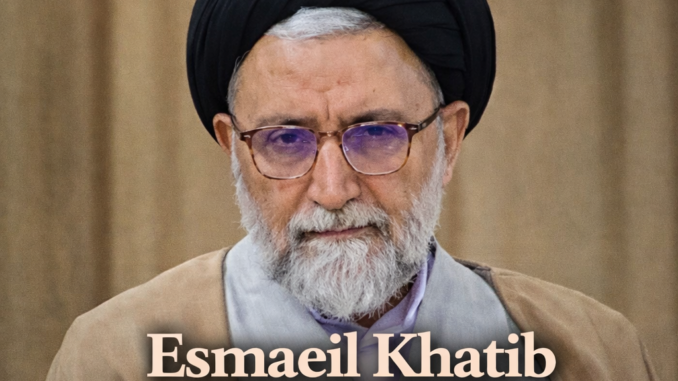
Who Is Esmaeil Khatib?
Esmaeil Khatib was an Iranian cleric, intelligence officer, and senior government official who served as the Minister of Intelligence of Iran from 2021 to 2026. A long-time insider within Iran’s powerful security and religious institutions, he built his career through decades of involvement in intelligence operations, judicial security structures, and the inner circle of the country’s leadership. He was widely regarded as one of the most influential figures in Iran’s intelligence community, known for his loyalty to the Islamic Republic and his close alignment with Supreme Leader Ali Khamenei.
Throughout his career, Khatib held several key security positions, including roles within the intelligence arm of the Islamic Revolutionary Guard Corps and the judiciary’s intelligence protection system. His appointment as Minister of Intelligence under President Ebrahim Raisi marked a peak in his career, placing him at the helm of Iran’s primary intelligence agency. During his tenure, he oversaw national security operations, counterintelligence efforts, and sensitive state surveillance programs, making him a central figure in shaping Iran’s internal and external security policies.
Esmaeil Khatib is currently trending due to his reported death in March 2026 during a high-profile airstrike in Tehran amid escalating regional tensions. His death has drawn global attention, not only because of his senior position but also due to his role in Iran’s intelligence strategy and controversial security crackdowns. A defining highlight of his career was his leadership of Iran’s intelligence ministry during a period of intense domestic unrest and geopolitical conflict, solidifying his legacy as a key architect of the country’s modern security apparatus.
Esmaeil Khatib Early Life and Background
Esmaeil Khatib was born in 1961 in the city of Qaen, located in eastern Iran. He grew up in a traditionally religious environment, rooted in the conservative social and cultural values of the region. His upbringing reflected the strong influence of Shiite Islam, which played a defining role in shaping his worldview from an early age.
Khatib was born into a devout Muslim family, where religious teachings and discipline were central to daily life. His family background is closely tied to Iran’s clerical culture, which encouraged early exposure to Islamic scholarship. As a child, he was known to be quiet, observant, and deeply inclined toward religious learning, often participating in local religious gatherings and Quranic studies.
During his formative years, Iran was undergoing significant political and social transformation, especially leading up to and following the Iranian Revolution. This period had a strong influence on young Khatib, reinforcing his interest in religious ideology and governance. His early passion for Islamic studies led him to pursue formal education in seminaries, particularly in the religious city of Qom, where many of Iran’s top clerics are trained.
From a young age, his interests were clearly aligned with theology, governance, and later, security matters. These early foundations set the stage for his eventual rise within Iran’s intelligence and political system.
Esmaeil Khatib Education
Esmaeil Khatib received his education primarily through Iran’s religious seminary system, which serves as the main pathway for clerical and ideological training in the country. He moved to the prominent religious center of Qom, where he enrolled in Islamic seminaries (hawza institutions) known for producing many of Iran’s top clerics and political figures.
In Qom, he studied Islamic jurisprudence (fiqh), principles of Islamic law (usul al-fiqh), and Quranic interpretation, which form the foundation of Shiite scholarly education. His academic training was deeply influenced by senior clerics, including Supreme Leader Ali Khamenei, under whom he is known to have studied. This mentorship helped shape both his ideological orientation and his future path within Iran’s ruling establishment.
Unlike Western-style academic systems, Khatib’s education did not focus on formal university degrees but rather on advanced religious certification and clerical ranking, eventually earning him the title Hujjat al-Islam, a respected mid-level clerical status. Alongside his theological studies, he also received specialized training in intelligence, security operations, and counterintelligence, particularly during his early involvement with the Islamic Revolutionary Guard Corps.
This combination of religious scholarship and security training served as his early career preparation, equipping him with both ideological authority and operational expertise. It positioned him for future roles within Iran’s intelligence institutions, where clerical loyalty and security knowledge are often closely intertwined.
Esmaeil Khatib Career and Rise in Intelligence
Esmaeil Khatib spent the majority of his professional life deeply embedded within Iran’s powerful security and intelligence system, gradually rising through its ranks to become one of its most trusted insiders. His career combined religious authority with operational intelligence work, a blend that is highly valued within the structure of the Islamic Republic.
Early Roles
Khatib began his intelligence journey in the 1980s, a period marked by instability following the Iranian Revolution. During this time, he joined the intelligence wing of the Islamic Revolutionary Guard Corps, an elite force responsible for protecting the revolution and maintaining internal security.
In these early years, he was involved in intelligence gathering, internal surveillance, and security operations aimed at consolidating the new government’s control. This period served as his foundation, where he gained hands-on experience in counterintelligence and learned the inner workings of Iran’s evolving security apparatus.
Key Positions Held
As his experience and loyalty became evident, Khatib was entrusted with increasingly sensitive roles across multiple institutions:
- Head of Intelligence in Qom (1990s):
In the religious city of Qom, he managed intelligence activities tied to clerical networks and religious institutions. This role was critical because Qom is the ideological heart of Iran’s leadership. - Senior Official in the Office of the Supreme Leader:
He later worked closely within the office of Ali Khamenei, handling sensitive security matters. This position placed him at the center of power and strengthened his political influence. - Security and Administrative Leadership Roles:
Khatib also served in high-level security positions linked to leadership protection and institutional oversight, where he was responsible for safeguarding key figures and facilities. - Head of Judiciary’s Intelligence Protection Center (2010s):
In this role, he oversaw internal security within Iran’s judicial system, ensuring loyalty and monitoring potential threats within the judiciary itself. - Security Chief at Astan Quds Razavi:
At Astan Quds Razavi, one of Iran’s most powerful religious and economic institutions, he managed security operations protecting assets, personnel, and strategic interests.
Through these roles, Khatib developed a reputation as a disciplined, loyal, and highly trusted intelligence figure. His steady rise was not based on public visibility but on behind-the-scenes influence and reliability.
By the time he was appointed Minister of Intelligence in 2021, he had already spent decades navigating Iran’s most sensitive security structures, making him a natural choice for one of the country’s most critical positions.
Esmaeil Khatib as Minister of Intelligence (2021–2026)
Esmaeil Khatib reached the peak of his career when he was appointed Minister of Intelligence in August 2021 by President Ebrahim Raisi, with approval from Iran’s parliament. His appointment reflected the trust placed in him by the country’s leadership, especially his close alignment with Supreme Leader Ali Khamenei.
As minister, Khatib headed Iran’s Ministry of Intelligence, the country’s primary civilian intelligence agency. In this role, he was responsible for overseeing a wide range of national security functions, including internal surveillance, counterintelligence, cyber operations, and foreign intelligence activities. His leadership came during a period marked by domestic unrest, cyber tensions, and increasing geopolitical pressure on Iran.
Khatib was widely regarded as a hardline security figure. Under his leadership, the intelligence ministry played a central role in monitoring political dissent and managing internal stability. His tenure coincided with major protests and opposition movements, during which the intelligence apparatus intensified surveillance and enforcement operations. He was seen as a key strategist in coordinating Iran’s internal security response and maintaining control during politically sensitive periods.
U.S. Sanctions and Controversies
In 2022, United States authorities imposed sanctions on Khatib. The sanctions were linked to allegations of cyber-enabled activities, repression of dissent, and involvement in operations targeting critics of the Iranian government. These measures placed him among several Iranian officials accused of contributing to human rights violations and restrictive security policies.
Critics and international observers associated his tenure with:
- Crackdowns on anti-government protests
- Expanded surveillance of citizens and activists
- Alleged involvement in cyber operations beyond Iran’s borders
Despite these controversies, within Iran’s political structure, Khatib remained a trusted and influential figure, maintaining strong support from the ruling establishment until the end of his tenure in 2026.
Esmaeil Khatib‘s Death In 2026
Esmaeil Khatib died on March 18, 2026, in Tehran, bringing an abrupt end to his tenure as Iran’s Minister of Intelligence. His death occurred during a period of heightened tension in the Middle East, where conflicts between Iran and its regional adversaries had intensified.
According to multiple reports, Khatib was killed in a targeted airstrike in Tehran. The strike was widely attributed to Israel, as part of a broader campaign aimed at senior Iranian military and intelligence figures. The operation reportedly targeted high-level security officials, making his death one of the most significant losses within Iran’s intelligence leadership in recent years.
His killing drew immediate international attention due to his position and influence within Iran’s security structure. As one of the country’s top intelligence officials, his death raised concerns about escalating covert conflict and retaliation in the region. Within Iran, it was seen as a major security breach and a symbolic attack on the state’s intelligence apparatus.
Khatib’s death marked the end of a decades-long career in intelligence and reinforced the risks faced by senior officials operating at the center of geopolitical and security confrontations.
Esmaeil Khatib Legacy and Long-Term Impact
Esmaeil Khatib left behind a legacy defined by deep influence within Iran’s security and intelligence architecture. Over the course of several decades, he helped shape the operational direction of the country’s intelligence institutions, particularly in areas of internal surveillance, counterintelligence, and state security enforcement. His career reflected the model of a loyal cleric-official whose authority came from both religious standing and strategic security roles.
One of his most lasting impacts was his role in strengthening coordination between key power centers, including the Islamic Revolutionary Guard Corps, the judiciary, and the office of Supreme Leader Ali Khamenei. Through these connections, he contributed to building a tightly controlled intelligence network that prioritized regime stability and centralized oversight. His influence extended beyond policy into the structure of how intelligence operations were managed across institutions.
Khatib’s tenure as Minister of Intelligence during a period of domestic unrest and geopolitical tension also defined how modern Iran approaches internal dissent and external threats. Supporters view his legacy as one of discipline, loyalty, and national security preservation, while critics associate his name with crackdowns, surveillance expansion, and restrictions on political freedoms.
In the long term, he is remembered as a key architect of Iran’s contemporary intelligence system, whose work reinforced the state’s ability to monitor, respond to, and control both internal and external challenges. His career continues to influence how intelligence leadership is structured and how security priorities are executed within the Islamic Republic.
Frequently Asked Questions (FAQ) About Esmaeil Khatib
1. Who is Esmaeil Khatib?
Esmaeil Khatib was an Iranian cleric and intelligence official who served as the Minister of Intelligence of Iran from 2021 to 2026. He was one of the most influential figures in Iran’s security establishment.
2. When and where was he born?
He was born in 1961 in Qaen, a city in eastern Iran.
3. What was his role in the Iranian government?
He served as the head of Iran’s intelligence ministry, overseeing internal security, counterintelligence, surveillance operations, and foreign intelligence activities.
4. Which organizations was he associated with?
He worked closely with key institutions such as the Islamic Revolutionary Guard Corps and the office of Supreme Leader Ali Khamenei.
5. Was Esmaeil Khatib sanctioned internationally?
Yes. In 2022, the United States imposed sanctions on him over allegations related to cyber activities and human rights violations.
6. What is he known for?
He is known for leading Iran’s intelligence ministry, playing a key role in national security strategy, and managing intelligence operations during a period of political tension.
7. How did he die?
He died on March 18, 2026, in Tehran, after being killed in a reported airstrike during regional conflict.
8. What was his religious status?
He held the clerical title Hujjat al-Islam, which is a respected mid-ranking position within Shiite Islamic scholarship.
9. Why is he considered important?
He is considered important because of his long-standing influence in Iran’s intelligence system and his role in shaping the country’s modern security policies.
Read more:
- Kerry Washington Biography: Age, Husband, Career, Net Worth, Movies, and Legacy
- Who Is Emir Balat? Full Biography, NYC Bomb Plot, Arrest & Charges Explained
Be the first to comment