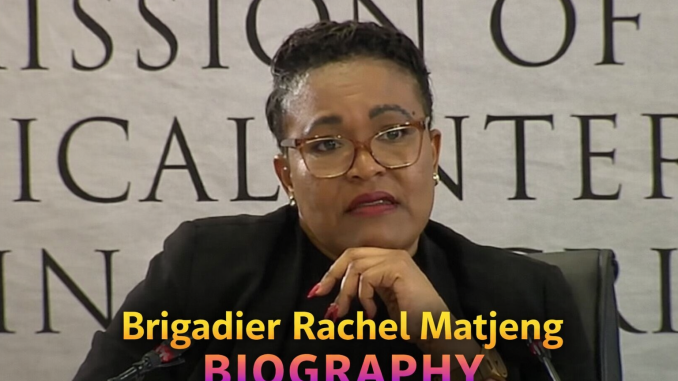
Brigadier Rachel Matjeng stands as one of the notable senior figures within the South African Police Service (SAPS), recognized for her leadership in forensic quality management and her contribution to strengthening investigative standards in South Africa. Serving at the heart of the country’s policing system, she plays a critical role in ensuring that criminal records, forensic evidence, and crime-scene procedures meet the levels of accuracy and integrity required for justice to be served.
With a career shaped by South Africa’s evolving law enforcement landscape after the end of apartheid, Matjeng represents a generation of officers who rose through the ranks during a time of institutional reform and increasing inclusion of women in leadership roles. Her position as a brigadier places her among the senior commanders responsible for guiding national forensic practices, influencing how crimes are investigated and how evidence is preserved for court proceedings.
In recent years, her name has gained wider public attention due to her involvement in high-profile inquiries, including testimony before the Madlanga Commission in February 2026. Her professional journey reflects both the demands of modern policing and the challenges of maintaining ethical trust in public service. Brigadier Matjeng’s story offers insight into the responsibilities, pressures, and impact of forensic leadership within one of Africa’s most complex law enforcement environments.
Brigadier Rachel Matjeng Early Life and Background
Details about Brigadier Rachel Matjeng’s early life remain largely private, reflecting her preference to keep her personal beginnings out of the public spotlight. She was born and raised in South Africa during a period of significant political and social transformation, as the country moved through the final decades of apartheid and into the democratic era beginning in 1994.
Growing up during a time of national unrest and structural change, Matjeng came of age in an environment where public service and community safety were increasingly important to the rebuilding of South African society. The transition to democracy also opened new opportunities for Black South Africans and for women to enter professional fields that had previously been limited, including law enforcement.
Matjeng’s background is closely tied to the evolving identity of SAPS as a modern police service striving to reflect the diversity of the country it serves. Her later rise into senior leadership suggests a foundation shaped by discipline, determination, and a strong commitment to justice and public duty.
Although specific information about her family life and childhood experiences has not been widely shared, her career path demonstrates a clear dedication to service and an enduring role in South Africa’s efforts to strengthen policing institutions in the post-apartheid era.
Brigadier Rachel Matjeng Education and Professional Training
Brigadier Rachel Matjeng’s educational and professional development laid the groundwork for her specialized career in policing and forensic services. While detailed public records of her academic qualifications remain limited, her senior responsibilities within SAPS indicate extensive training in areas closely linked to criminal investigation, forensic science, and quality management.
Like many officers in the South African Police Service, Matjeng would have begun her journey through formal SAPS police training programs, which provide foundational instruction in law enforcement practices, ethics, criminal law, investigative procedures, and community policing. Such training is essential for officers entering a demanding and evolving security environment.
As her career advanced, Matjeng moved into the highly technical field of forensic services, a division that requires additional expertise in evidence handling, crime-scene processing, and the maintenance of accurate criminal records. Her leadership role in quality management suggests further professional preparation in oversight systems, operational standards, and forensic compliance measures that ensure investigative work meets both national and international expectations.
Her career reflects the importance of continuous learning within SAPS, where senior officers are often required to complete ongoing courses in management, forensic governance, and institutional accountability. Matjeng’s progression into a high-ranking forensic leadership position demonstrates a blend of practical policing experience and specialized professional development.
Brigadier Rachel Matjeng Career in the South African Police Service
Brigadier Rachel Matjeng has built a long-standing career within the South African Police Service, serving during a period when SAPS has undergone significant reform and modernization in the democratic era. After completing her initial training, she began her service in general policing roles, gaining firsthand experience in the operational demands of law enforcement and criminal investigation.
Over time, Matjeng transitioned into more specialized work, focusing on forensic services—one of the most critical divisions in modern policing. Forensic services play a central role in crime-solving by ensuring that evidence collected from crime scenes is scientifically processed, properly documented, and suitable for use in court proceedings.
By the mid-2010s, Matjeng had established herself in the field of forensic quality management, where her responsibilities extended beyond routine investigation into the oversight of national standards. Her work involves monitoring the accuracy of criminal records, improving crime-scene handling procedures, and ensuring that forensic practices remain consistent, reliable, and legally defensible.
Stationed primarily in Pretoria, where SAPS headquarters and major forensic operations are based, she has contributed to strengthening systems that support thousands of investigations each year. Through her focus on quality assurance, Matjeng has played a role in reducing procedural errors, supporting fair trials, and reinforcing the credibility of forensic evidence in South Africa’s justice system.
Her career highlights the growing importance of forensic leadership in addressing complex crime challenges, while also reflecting the pressures faced by senior officers working within one of the country’s most scrutinized public institutions.
Brigadier Rachel Matjeng Rise to Brigadier Rank and Leadership Role
Through years of dedicated service and professional expertise, Rachel Matjeng rose through the ranks of the South African Police Service to attain the senior position of brigadier. Within SAPS, the rank of brigadier represents a significant level of leadership, typically assigned to officers responsible for overseeing major divisions and shaping national operational standards.
Matjeng’s advancement reflects both her experience and her specialized competence in forensic services, an area increasingly vital to modern policing. Her promotion into senior command was driven by her ability to manage complex investigative support systems, particularly those involving criminal records, evidence integrity, and crime-scene quality control.
As a brigadier based in Pretoria, she holds a strategic role in ensuring that forensic procedures across SAPS meet required professional and legal standards. This includes guiding teams, contributing to policy enforcement, and maintaining systems that support the credibility of evidence presented in criminal courts.
Her rise also carries broader significance within the transformation of South African policing. In a sector historically dominated by male leadership, Matjeng’s position represents the growing presence of women in senior law enforcement roles. Her career serves as an example of how expertise, discipline, and long-term commitment can lead to influential leadership within one of the country’s most essential public institutions.
Brigadier Rachel Matjeng Public Scrutiny and the Madlanga Commission Testimony (2026)
In early 2026, Brigadier Rachel Matjeng came under heightened public attention following her testimony before the Madlanga Commission, a high-profile inquiry examining allegations of interference in South Africa’s justice system and potential corruption within policing structures. The commission’s work reflects broader national concerns about accountability, ethical conduct, and public trust in law enforcement institutions.
Matjeng’s appearance before the commission in February 2026 placed her professional and personal associations under scrutiny, particularly in relation to businessman Vusimuzi “Cat” Matlala, with whom she had maintained a personal relationship over several years. Matlala’s business connections, including links to SAPS-related tenders, raised questions about potential conflicts of interest within the police service.
During her testimony, Brigadier Rachel Matjeng acknowledged receiving gifts and financial support from Matlala but maintained that these were personal in nature and not connected to her official responsibilities. She further denied any improper influence over procurement processes or contract decisions, stating that her actions remained within the boundaries of her duties and that she did not interfere with tender outcomes.
The commission’s inquiry highlighted the sensitive ethical expectations placed on senior officers, especially those in positions of authority within critical divisions such as forensic services. Matjeng’s involvement illustrates how personal relationships can become deeply intertwined with professional accountability in public service.
As of February 2026, the outcomes of the commission’s findings and any resulting investigations remained pending, making this period one of the most publicly significant and closely watched chapters in her career.
Brigadier Rachel Matjeng Personal Life
Brigadier Rachel Matjeng has generally maintained a private personal life, with limited details publicly available outside of official proceedings and testimony. Despite her senior position within SAPS, she has largely kept her family background and personal affairs away from media attention, reflecting a reserved approach to public exposure.
Some aspects of her private life became widely known due to her testimony before the Madlanga Commission in February 2026. During these proceedings, Matjeng spoke openly about her relationship with businessman Vusimuzi “Cat” Matlala, whom she met in 2017 through a colleague. Their relationship, described as intermittent over several years, continued until Matlala’s arrest in 2026.
In her testimony, Matjeng characterized Matlala as respectful and supportive, noting that he expressed affection through gifts and financial assistance. She emphasized that these exchanges were personal and not connected to her professional role within SAPS. She also stated that the relationship was known within her close circle of friends and family.
The public focus on her personal life emerged largely because of Matlala’s reported business involvement with SAPS tenders, raising broader concerns about transparency and ethical boundaries for officers in senior leadership. Matjeng denied any wrongdoing or improper influence, stressing the importance of separating personal relationships from official responsibilities.
Her experience underscores the unique pressures faced by high-ranking public servants, where private associations can quickly become matters of national scrutiny and institutional accountability.
Brigadier Rachel Matjeng Legacy and Impact
Brigadier Rachel Matjeng’s career reflects the growing importance of forensic leadership within South African policing and the evolving role of women in senior law enforcement positions. Through her work in forensic quality management, she has contributed to strengthening the standards that govern how crime-scene evidence and criminal records are handled within the South African Police Service.
Her responsibilities have placed her at the center of systems that support justice outcomes, where accuracy, reliability, and procedural integrity are essential. By focusing on quality assurance in forensic services, Matjeng has played a role in ensuring that evidence presented in court meets professional expectations, ultimately supporting fair trials and effective criminal investigations.
At the same time, her public involvement in the Madlanga Commission proceedings highlights the complex ethical pressures faced by senior officers in modern policing. Her experience illustrates how leadership in public institutions requires not only professional competence but also heightened transparency and accountability, particularly in an environment where public trust remains fragile.
Brigadier Rachel Matjeng’s story stands as part of the broader transformation of SAPS in the post-apartheid era, where more diverse leadership has emerged and forensic science has become increasingly central to crime-solving. Regardless of ongoing scrutiny, her career demonstrates both the influence and the challenges carried by those who serve at the highest levels of law enforcement.
Frequently Asked Questions About Brigadier Rachel Matjeng
1. Who is Brigadier Rachel Matjeng?
Brigadier Rachel Matjeng is a senior officer in the South African Police Service, known for her leadership in forensic quality management and oversight of evidence-handling standards.
2. What is Brigadier Rachel Matjeng role within SAPS?
She works in forensic services, focusing on maintaining quality control in criminal records, crime-scene procedures, and evidence integrity.
3. Why did she appear before the Madlanga Commission?
She testified in February 2026 as part of an inquiry into alleged corruption, justice interference, and tender-related concerns within SAPS.
4. What is Brigadier Rachel Matjeng connection to Vusimuzi “Cat” Matlala?
Matjeng acknowledged having a personal relationship with Matlala beginning in 2017, which later drew attention due to his reported business links to SAPS tenders.
5. Has Brigadier Rachel Matjeng been found guilty of wrongdoing?
As of February 2026, investigations and outcomes connected to the commission’s findings were still pending, with no final conclusions publicly confirmed.
6. What is her significance in South African policing?
Her career highlights the increasing role of forensic science in investigations and reflects the rise of women into senior leadership roles within SAPS.
Read more:
- Aunty Ajara Biography: Life, Death, Age, Husband and Legacy
- Nancy Guthrie Biography: Life, TMZ, Disappearance and Investigation
Be the first to comment