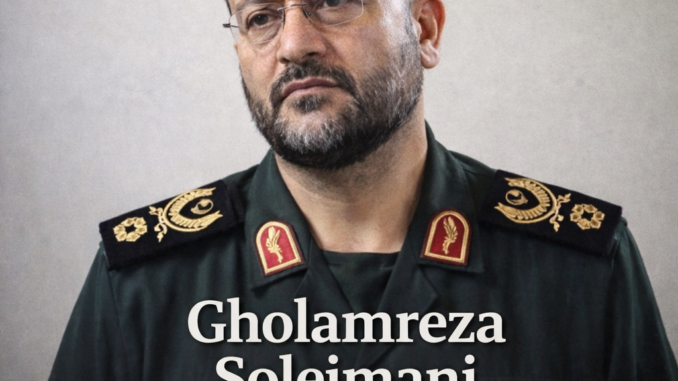
Who Is Gholamreza Soleimani?
Gholamreza Soleimani was an Iranian military commander and senior officer in the Islamic Revolutionary Guard Corps (IRGC). He was best known for serving as the commander of the Basij Resistance Force, a powerful paramilitary organization responsible for internal security and ideological mobilization within Iran. Throughout his career, Soleimani became one of the most influential figures within Iran’s security establishment.
As commander of the Basij militia, Soleimani oversaw a nationwide network of volunteers and paramilitary members responsible for enforcing government policies, mobilizing support during national crises, and maintaining order during periods of unrest. His leadership placed him at the center of Iran’s strategy for internal security and political stability.
In March 2026, Soleimani gained international attention after reports emerged that he had been killed in an Israeli airstrike during escalating tensions between Iran and Israel. The incident brought renewed global focus to his decades-long role within Iran’s military leadership.
Early Life and Background
Gholamreza Soleimani was born in 1964 in Farsan, located in Chaharmahal and Bakhtiari Province in western Iran. He grew up during a period of intense political transformation that eventually led to the Iranian Revolution of 1979.
The revolution dramatically changed Iran’s political and military structures. New institutions were created to defend the Islamic Republic and protect its ideology. These developments influenced many young Iranians, including Soleimani, who later joined the newly established security forces.
Growing up during this revolutionary period shaped his political outlook and set the foundation for his future career in Iran’s military and security institutions.
Military Career
Joining the Islamic Revolutionary Guard Corps
After the 1979 Iranian Revolution, Soleimani joined the Islamic Revolutionary Guard Corps, a military organization created to defend the Islamic Republic and protect its revolutionary ideology.
His early service coincided with the Iran–Iraq War (1980–1988), one of the most defining conflicts in modern Iranian history. During the war, Soleimani gained battlefield experience and developed leadership skills that helped him advance through the ranks of the IRGC.
The war played a major role in shaping the careers of many Iranian commanders, and Soleimani’s participation established him as part of a generation of military leaders formed during that conflict.
Command Positions
Over the following years, Soleimani rose through the ranks of the IRGC and held several major command positions within the organization. These roles gave him experience managing large military units and coordinating operations.
His leadership positions included command roles in:
- 19th Fajr Division
- 41st Tharallah Division
- 14th Imam Hossein Division
These commands helped establish him as an experienced military leader within the Revolutionary Guard.
Provincial Leadership in Isfahan
Before assuming national leadership within the Basij organization, Soleimani served as the head of the IRGC Isfahan Provincial Corps.
Isfahan is one of Iran’s most important provinces, both economically and strategically. As provincial commander, Soleimani supervised military units, coordinated with local authorities, and oversaw security operations in the region.
This role further strengthened his reputation within the IRGC and prepared him for higher leadership responsibilities.
Commander of the Basij Resistance Force
In July 2019, Soleimani was appointed commander of the Basij Resistance Force by Iran’s Supreme Leader Ali Khamenei.
The Basij is a nationwide paramilitary organization operating under the IRGC. It has millions of members and plays a significant role in Iranian society.
The organization’s responsibilities include:
- Supporting national defense
- Enforcing religious and social regulations
- Mobilizing volunteers during national emergencies
- Assisting government institutions during crises
- Maintaining internal security during protests
Under Soleimani’s leadership, the Basij remained one of the most powerful institutions involved in maintaining domestic stability within Iran.
Controversies and International Sanctions
Despite its official role in national security, the Basij has been criticized internationally for its actions during political protests in Iran.
Human rights organizations accused the militia of participating in the suppression of demonstrations, particularly during nationwide protests in 2019.
In January 2026, former U.S. President Donald Trump publicly claimed that Soleimani was among the Iranian officials responsible for the killing of protesters during crackdowns by Iranian security forces. Trump’s statement drew renewed international attention to Soleimani’s role within Iran’s internal security structure and intensified criticism of the Basij militia.
As a result of these allegations and broader concerns about human rights violations, the United States Department of the Treasury and other Western governments imposed sanctions on Soleimani. Iranian authorities rejected the accusations, maintaining that the Basij operates to protect national security and maintain public order during periods of unrest.
Iranian authorities rejected these accusations, stating that the Basij’s role was to maintain public order and protect national stability.
Death
Reports about the death of Gholamreza Soleimani emerged on 17 March 2026 during escalating hostilities between Iran and Israel. Israeli officials announced that Soleimani, who served as commander of the Basij Resistance Force, was killed in a targeted airstrike in Tehran.
According to Israeli military statements, the operation targeted senior figures in Iran’s security leadership and aimed to disrupt command structures connected to the Islamic Revolutionary Guard Corps and its affiliated forces.
Initial reports indicated that the strike occurred as part of a broader series of attacks against Iranian military and government facilities. If confirmed, Soleimani’s death would represent one of the most significant losses within Iran’s security leadership during the conflict.
Iranian authorities did not immediately confirm the details surrounding the incident, and independent verification remained limited at the time the reports emerged. The news nevertheless drew international attention and highlighted the intensifying confrontation between Iran and Israel.
Legacy and Influence
Over several decades of service, Soleimani became one of the key figures responsible for shaping Iran’s internal security policies.
As commander of the Basij Resistance Force, he directed one of the most influential paramilitary organizations in the country. The Basij’s nationwide presence allowed it to play a major role in maintaining internal order and mobilizing volunteers in support of government initiatives.
Soleimani’s career reflects the broader importance of the Islamic Revolutionary Guard Corps in the political and security structure of modern Iran.
FAQ About Gholamreza Soleimani
1. Who was Gholamreza Soleimani?
Gholamreza Soleimani was an Iranian military commander and Brigadier General in the Islamic Revolutionary Guard Corps.
2. What was his role in Iran?
He served as commander of the Basij Resistance Force, a nationwide paramilitary organization responsible for internal security.
3. When was Gholamreza Soleimani born?
He was born in 1964.
4. Where was he born?
He was born in Farsan, in western Iran.
5. When did Gholamreza Soleimani die?
Reports indicated that he was killed on 17 March 2026 during an Israeli airstrike in Tehran.
Read More:
- Ali Larijani Biography: Early Life, Political Career, Family, Net Worth, and Influence in Iran Politics
- Capt. Seth R. Koval Biography: Air National Guard Pilot, Military Career, Family, and 2026 Iraq KC-135 Crash
Be the first to comment