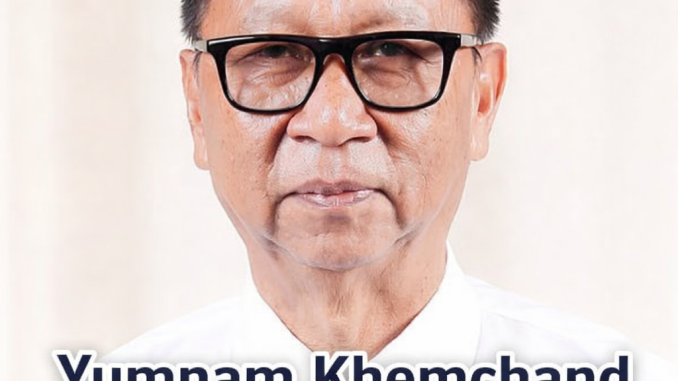
Yumnam Khemchand Singh is a prominent Indian politician from Manipur whose public life reflects a rare blend of legislative experience, grassroots leadership, and personal discipline shaped by martial arts. Born on 1 March 1963 in Singjamei, Imphal, he has emerged as a key figure in the state’s political landscape, representing the Singjamei Assembly constituency and holding influential roles within the Manipur government. Known for his steady rise through the ranks of the Bharatiya Janata Party (BJP), Khemchand Singh’s career spans legislative leadership, ministerial responsibility, and a reputation for resilience during periods of political and social uncertainty. This biography traces his early life, family background, education, political journey, and the values that continue to define his public service.
Yumnam Khemchand Educational Background
Yumnam Khemchand Singh completed his formal education up to the secondary school level, having passed the 10th standard. His educational foundation was laid in Manipur, where he grew up and developed an early understanding of the social, cultural, and administrative realities of the state.
Although he did not pursue higher or university education, his schooling provided the groundwork for a life rooted in discipline, public engagement, and leadership. Over time, his practical experience in community affairs, governance, and organizational work compensated for the absence of advanced academic credentials. His rise in public life reflects a career shaped more by on-ground political experience, legislative exposure, and personal commitment than by formal higher education.
Khemchand Singh’s educational journey underscores a path common to many grassroots leaders in India—where lived experience, local credibility, and sustained public service play a defining role in leadership development.
Yumnam Khemchand Political Career
Yumnam Khemchand Singh has built his political career within the Bharatiya Janata Party, where he steadily rose through the ranks to become one of the party’s most influential leaders in Manipur. His political trajectory reflects consistency at the grassroots level as well as trust within the party’s legislative leadership.
He was first elected as a Member of the Manipur Legislative Assembly (MLA) from the Singjamei constituency in 2017, marking his entry into the state legislature. His re-election in 2022 from the same constituency reaffirmed his political standing and voter confidence, establishing him as a key representative of the Imphal region.
Between 2017 and 2022, Khemchand Singh served as the Speaker of the Manipur Legislative Assembly, a constitutionally significant role that placed him at the center of legislative functioning. As Speaker, he was responsible for maintaining parliamentary discipline, overseeing debates, and ensuring the smooth conduct of assembly proceedings during a politically sensitive period in the state.
Following his tenure as Speaker, he went on to hold several ministerial portfolios in the Manipur government, including Municipal Administration, Housing Development, Rural Development & Panchayati Raj, and Education. In these roles, he was involved in urban governance, rural infrastructure development, local self-government, and educational administration, giving him broad exposure across both urban and rural policy domains.
Until the imposition of President’s Rule in early 2025, Khemchand Singh remained an active member of the state’s executive leadership. During periods of political instability, he emerged as a stabilizing figure within the BJP, contributing to internal coordination and continuity in governance. His political career is characterized by legislative experience, executive responsibility, and sustained involvement in Manipur’s governance during times of transition and challenge.
Yumnam Khemchand As Chief Minister of Manipur
In early February 2026, Yumnam Khemchand Singh was elected leader of the BJP legislative party, a decision that positioned him to assume office as the 13th Chief Minister of Manipur. His elevation marked a significant political transition, bringing an experienced legislator and former Speaker to the helm of the state’s executive leadership.
Khemchand Singh’s leadership emerged at a critical juncture in Manipur’s history. The state had been under President’s Rule for nearly a year, following prolonged ethnic violence and political instability. His selection was widely viewed as an attempt to restore constitutional governance, administrative continuity, and public confidence after an extended period of central rule.
As part of a broader inclusive leadership framework, Nemcha Kipgen was appointed Deputy Chief Minister, representing the Kuki community. This arrangement was designed to reflect ethnic representation and balance at the highest level of government, reinforcing the administration’s stated commitment to reconciliation, dialogue, and unity across communities.
Khemchand Singh’s assumption of office as Chief Minister symbolized a return to elected governance in Manipur, with expectations centered on stabilization, peace-building, and administrative rebuilding. His long legislative experience, combined with prior executive roles, positioned him as a leader tasked with guiding the state through recovery and renewed political normalcy.
Yumnam Khemchand As a Martial Arts Mentor
Beyond politics, Yumnam Khemchand Singh is widely recognized for his deep and lifelong commitment to taekwondo, a discipline that has played a defining role in shaping his personal values and public image. He began training in taekwondo during his teenage years, at a time when martial arts culture was steadily gaining prominence in Manipur. What started as a personal pursuit gradually evolved into a sustained journey of mastery, discipline, and mentorship.
In December 2025, Khemchand Singh achieved a historic milestone by becoming the first Indian to be awarded a 5th-dan black belt in traditional taekwondo by the World Traditional Taekwondo Federation in Seoul, South Korea. This recognition placed him among a select group of high-ranking practitioners worldwide and underscored his long-standing dedication to the art beyond a ceremonial or honorary level.
His engagement with taekwondo extends beyond personal achievement. Over the years, he has been actively involved in promoting martial arts in India, particularly in Manipur, a state known for producing athletes and martial artists of national and international repute. He has consistently emphasized the role of martial arts in youth development, physical fitness, mental discipline, and character building, viewing it as a constructive pathway for social engagement and personal growth.
Khemchand Singh’s martial arts background is often cited as a reflection of his broader approach to life and leadership—grounded in discipline, perseverance, respect, and self-control—qualities that have also influenced his conduct in public service and governance.
Yumnam Khemchand‘s Role in Peace & Reconciliation
Yumnam Khemchand Singh has played a visible role in efforts aimed at easing ethnic tensions in Manipur, particularly in the aftermath of the prolonged violence that erupted in 2023. At a time when mistrust and displacement had deeply affected community relations, he undertook outreach visits to tribal and conflict-affected areas, including villages outside the Imphal valley. These visits were intended to listen directly to local concerns, signal political engagement beyond ethnic lines, and encourage a return to dialogue.
In public statements and interactions, Khemchand Singh consistently underscored that peaceful dialogue and reconciliation were the only sustainable path forward for the state. He emphasized coexistence, mutual respect, and constitutional methods as the foundation for resolving long-standing grievances, positioning political leadership as a bridge rather than a divider during crisis periods.
His approach during this phase focused on confidence-building and symbolic reassurance—acknowledging pain across communities while advocating restraint and communication. While the conflict itself required broader institutional and security responses, Khemchand Singh’s role was aligned with political outreach, moral persuasion, and community engagement, reinforcing his image as a leader willing to step beyond partisan boundaries in moments of social fracture.
Yumnam Khemchand Personal Life & Family Background
Yumnam Khemchand Singh was born on 1 March 1963 in Singjamei, Imphal, Manipur, into a Meitei family rooted in the cultural and social traditions of the Imphal valley. His family background reflects a modest upbringing closely connected to the local community, an influence that continues to shape his political identity and public engagement.
His father, Late Yumnam Kalachand Singh, is recorded in official election documents, and Khemchand Singh has often been identified as a leader whose values were shaped by family discipline, respect for elders, and community responsibility. While he maintains a public presence through his political work, he has largely kept his private life away from media attention.
Khemchand Singh is married, and his wife is listed as a housewife in official affidavits. Consistent with his preference for privacy, details about his children—if any—have not been publicly disclosed in election records or major media profiles. This deliberate separation between public duty and personal life has remained a defining feature of his public persona.
Known for a disciplined lifestyle influenced by his long-standing involvement in martial arts, he is regarded as reserved, focused, and personally grounded. His personal life reflects stability and restraint, reinforcing an image of a leader shaped as much by family values and self-discipline as by political ambition.
Yumnam Khemchand Legacy
Yumnam Khemchand Singh’s legacy is defined by institutional leadership, personal discipline, and steady political continuity during some of the most challenging periods in Manipur’s recent history. Over the course of his public life, he has come to represent a form of leadership rooted less in rhetoric and more in endurance, procedural authority, and presence during uncertainty.
As a two-time MLA, former Speaker of the Manipur Legislative Assembly, senior cabinet minister, and ultimately Chief Minister, his career reflects a rare progression through all major layers of state governance—legislative, executive, and constitutional. His tenure as Speaker, in particular, is remembered for reinforcing legislative order and continuity at a time when political stability was fragile.
Khemchand Singh’s elevation to Chief Minister following an extended period of President’s Rule situates his legacy within a broader narrative of restoration and transition. He is likely to be remembered as a leader entrusted with guiding Manipur back to elected governance, reconciliation, and administrative normalcy after prolonged disruption.
Beyond politics, his standing as a high-ranking taekwondo practitioner adds an uncommon dimension to his public image. The values associated with martial arts—discipline, restraint, perseverance, and respect—have become closely linked to how his leadership style is perceived, distinguishing him from many contemporaries.
Ultimately, his legacy is shaped by consistency over spectacle: a leader who rose through sustained service, maintained personal privacy, and navigated governance with a disciplined, methodical approach. In Manipur’s political history, Yumnam Khemchand Singh occupies a place as a stabilizing figure whose influence is tied to structure, endurance, and the long arc of public service rather than momentary prominence.
Conclusion
Yumnam Khemchand Singh’s life and career present the portrait of a leader shaped by discipline, continuity, and lived experience rather than privilege or spectacle. From his early years in Singjamei to the highest office of the state, his journey reflects a steady ascent grounded in grassroots politics, legislative responsibility, and personal restraint.
His path—from a 10th-standard education to serving as Speaker, senior cabinet minister, and Chief Minister of Manipur—underscores the role of perseverance, practical governance, and institutional understanding in political leadership. At moments of profound instability, he emerged as a figure associated with order, reconciliation, and the restoration of democratic governance.
Equally significant is the integration of his martial arts philosophy into public life, reinforcing values of self-control, respect, and resilience that resonate beyond politics. By maintaining a clear boundary between public service and private life, he has preserved a sense of personal integrity while remaining deeply engaged with the responsibilities of leadership.
Taken together, Yumnam Khemchand Singh’s story is one of measured leadership and enduring service—a legacy still unfolding, but already marked by stability, discipline, and a commitment to guiding Manipur through periods of challenge toward institutional and social renewal.
Frequently Asked Questions About Yumnam Khemchand
1. Who is Yumnam Khemchand Singh?
He is an Indian politician from Manipur and a senior leader of the Bharatiya Janata Party. He has served as MLA, Speaker, minister, and Chief Minister of Manipur.
2. What is Yumnam Khemchand’s date of birth and age?
He was born on 1 March 1963. He is 62 years old as of 2026.
3. Where is Yumnam Khemchand from?
He hails from Singjamei, Imphal, in Manipur.
4. What is his educational qualification?
He completed formal education up to the 10th standard.
5. Is Yumnam Khemchand married?
Yes. He is married, and his wife is listed as a housewife in official records.
6. Does Yumnam Khemchand have children?
Details about his children have not been publicly disclosed.
7. Which political party doesYumnam Khemchand belong to?
He is a member of the Bharatiya Janata Party (BJP).
8. When did Yumnam Khemchand become Chief Minister of Manipur?
He was elevated to the post in February 2026, following the end of President’s Rule.
9. What major roles has Yumnam Khemchand held before becoming Chief Minister?
He served as Speaker of the Manipur Legislative Assembly and later as a cabinet minister handling multiple portfolios.
10. Is he associated with martial arts?
Yes. He is a dedicated taekwondo practitioner and holds a 5th-dan black belt in traditional taekwondo.
Read more:
- Patricia Mashale Biography: Life, Age, Defamation Lawsuit 2026 and Legacy
- Marjan Hussein Marjan Biography: Life, Career, Family and Resignation as IEBC Chairman
Be the first to comment